ReSound Sensia is built around a specific complaint that almost every hearing aid wearer has had: in a noisy room, the device amplifies whoever is loudest, not whoever you’re actually talking to. Sensia’s whole design goal is to fix that — to prioritize the person you’re facing, automatically, without you touching an app. Here’s how it works and who it suits.

What Makes ReSound Sensia Different
ReSound calls the approach Intelligent All-Around. It isn’t one feature — it’s three systems that finally work together without the wearer having to manage them:
- AcoustIQ — an environment classifier that recognizes what kind of situation you’re in. ReSound reports 91% accuracy in classifying the environment, and 88% greater accuracy in real-time classification and feature engagement than the closest competitor.
- Four-microphone beamforming — a binaural directional system that emphasizes the person in front of you, which is almost always the person you’re talking to.
- Deep Neural Network (DNN) denoising — trained on real-world noise, and roughly 17× more computationally efficient than other AI-powered hearing solutions, which is how it runs continuously without destroying battery life.
The headline change is not any one of those in isolation — it’s that Sensia decides when to use them for you. On the previous generation, getting the full benefit of neural-network noise reduction often meant knowing to switch into a specific program. On Sensia, that happens automatically, driven by AcoustIQ’s read of the room.
What patients describe: the noise recedes, the person across the table comes forward, and you didn’t have to do anything.
ReSound backs this with external validation rather than in-house testing alone. Hörzentrum Oldenburg — an independent German hearing research institute — found Sensia to be the only solution combining four-microphone beamforming and DNN noise reduction simultaneously, for better audibility and lower listening effort in noise. In ReSound’s user studies, 83% experienced superior speech clarity in noise compared with the closest competitor, and the forward-facing beam was preferred 93% of the time.
Form Factors
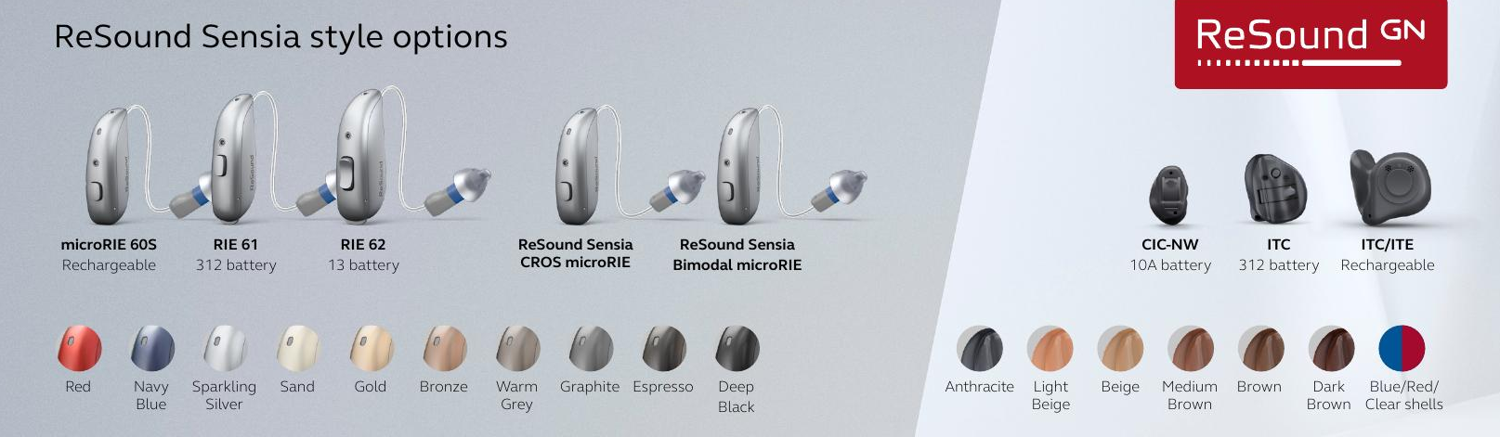
Sensia comes in a wide range of styles, all running the same AI sound processing:
- microRIE (60S) — the smallest of the range and among the smallest AI hearing aids on the market. Rechargeable. Best for patients who prioritize maximum discretion.
- RIE 61 (size 312) — receiver-in-ear using replaceable 312 batteries. Slightly larger housing, easier handling for patients with dexterity considerations.
- RIE 62 (size 13) — receiver-in-ear using replaceable 13 batteries, for the longest runtime between changes. Good for frequent travelers who don’t want to manage a charger.
- Rechargeable ITC / ITE customs — custom-molded in-the-ear styles, rechargeable.
- Wireless ITC and non-wireless CIC customs — for patients who want nothing behind the ear at all.
- CROS / BiCROS — for single-sided deafness.
Sensia also offers bimodal models designed to work alongside Cochlear® Nucleus® sound processors — relevant if you have a cochlear implant on one side and wear a hearing aid on the other.
The choice between these is about lifestyle, dexterity, and cosmetics — not about sound quality. They share the platform.
Technology Levels
Sensia is sold in tiers, and the practical difference is worth understanding before you shop:
- Sensia 9 — the top tier. Strongest DNN noise reduction (up to −15 dB), Intelligent All-Around directionality, and 17 warp bands for the finest fine-tuning.
- Sensia 7 — considerable DNN noise reduction (up to −12 dB), 360 All-Around directionality, 14 warp bands.
- Sensia 5 and 4 — the same core sound and connectivity, without the DNN denoising, and with fewer bands for fine-tuning.
If hearing in noise is your main frustration, that automatic-versus-manual distinction is the thing to weigh. Dr. Rossetti will walk through it with you rather than defaulting you to the top tier.
Who ReSound Sensia Works Well For
- Adults with mild to severe hearing loss — the range covers the standard audiometric profile.
- Patients whose main complaint is noisy restaurants and group conversation — this is the specific problem Sensia was designed against, and the forward-facing beamformer plus automatic DNN is a strong combination for it.
- Patients who don’t want to manage an app — the whole point of Sensia is that the right features turn on without you asking.
- Patients who’ve struggled with “over-processed” hearing aids — ReSound’s house sound stays comparatively natural.
- Patients who want maximum discretion — the microRIE 60S is genuinely tiny.
- Patients who want a custom in-the-ear device with current AI — Sensia’s custom range is broader than most flagship platforms.
- Cochlear implant users — the bimodal models pair with Cochlear Nucleus processors.
- Patients who use public venues — Auracast reception works at launch.
Where It’s Less of a Fit
- Profound hearing loss — the small form factors limit maximum amplification. ReSound’s ENZO IA Super Power BTE is the right conversation for profound loss.
- Patients who prioritize completely invisible — Sensia’s CIC is discreet, but Phonak Lyric remains the only truly invisible extended-wear option.
- Very heavy streamers — ReSound rates the rechargeable models at 24 hours. That comfortably covers a day, but heavy streaming will shorten it.
- Patients on older phones — full feature access needs a reasonably modern handset. We’ll check your specific device before recommending.
Color Options
What You Get With ReSound Sensia
- Intelligent All-Around — AcoustIQ classification, four-mic beamforming, and DNN denoising coordinated automatically
- AcoustIQ environment recognition — 91% accuracy classifying the environment; 88% greater accuracy in real-time classification and feature engagement than the closest competitor
- Deep Neural Network noise reduction — about 17× more efficient than other AI hearing solutions
- Binaural four-microphone directional system — prioritizes the person you’re facing
- NoiseTracker II for non-speech noise environments, and DFS Ultra III feedback management
- Bluetooth LE Audio — iPhone, iPad, and Android
- Auracast broadcast reception — working at launch, not a future promise
- Made for iPhone (MFi) and ASHA support
- Rechargeable options — 24 hours of battery life in the rechargeable microRIE and ITC/ITE styles, even with DNN denoising activating automatically; plus zinc-air 312 and 13 options
- Wide form factor range — microRIE, RIE, custom ITC/ITE, CIC, and CROS/BiCROS
- Bimodal models for Cochlear® Nucleus® users
- Tinnitus sound generator built in
- Four fully customizable programs
What Changed From the ReSound Vivia
Sensia is ReSound’s current platform, launched in August 2026, and it replaces Vivia as the flagship we fit. The two share a great deal of hardware DNA — if you compared them side by side on a table they would look familiar. The meaningful difference is in coordination and automation.
On Vivia, the neural-network noise reduction was excellent but often depended on the wearer selecting the right program. On Sensia, AcoustIQ reads the environment and switches the DNN, the beamformer and the noise management on and off together, without input from you.
If you currently wear Vivia and it’s serving you well, this is not a reason to replace it. For a new fitting, Sensia is what we recommend.
The Organic Hearing Philosophy
ReSound’s engineering approach has a name: Organic Hearing. It’s a long-standing design philosophy at GN Hearing (ReSound’s parent company), and it shapes every aspect of how their hearing aids process sound.
The core idea: human hearing is fundamentally a brain activity, not just an ear activity. Your brain naturally filters, localizes, and prioritizes sound. A hearing aid’s job is to feed the brain enough acoustic information to do that work, not to make those decisions for the brain.
In practical terms, ReSound devices tend to sound more natural and less fatiguing than aggressively-processed alternatives, especially over long days. Patients often comment that they don’t feel like they’re “wearing” the hearing aid after the first week of acclimation.
How We Fit ReSound Sensia at Florida Hearing Matters
Every Sensia fitting at Florida Hearing Matters includes:
- Comprehensive audiometric evaluation — mapping your exact hearing loss profile
- Form factor consultation — we’ll walk through which Sensia style matches your needs (size, battery preference, dexterity, lifestyle, cosmetics)
- Technology level guidance — an honest conversation about which technology level actually earns its cost for your listening life, rather than defaulting you to the top one
- Real-ear verification — we measure what the hearing aid is delivering to your eardrum and program accordingly
- App setup — pairing with your phone, walking through Auracast, customizing your programs
- Follow-up visits included — typically three in the first 60 days to fine-tune as your brain adjusts
- 60-day satisfaction guarantee — if Sensia isn’t the right fit, return it. No pressure.
Frequently Asked Questions
What does “Intelligent All-Around” actually mean?
It’s ReSound’s name for three systems working together automatically: AcoustIQ recognizes what environment you’re in, a four-microphone beamformer emphasizes the person in front of you, and a deep neural network strips out noise. Other hearing aids have versions of these features, but often leave it to you to switch programs to get them. Sensia’s claim is that it activates the right combination on its own, and does so more accurately than competing systems.
How is Sensia different from the ReSound Vivia?
Sensia launched in August 2026 and is the platform we now fit. It shares a lot of hardware with Vivia, and the two look similar. The real difference is automation: on Vivia, getting the full benefit of the neural-network noise reduction often meant selecting the right program yourself. On Sensia the system reads the room and switches those features on for you. If you already wear Vivia and are happy, there’s no need to change.
Sensia comes in different technology levels — which do I need?
Sensia is sold as levels 9, 7, 5 and 4. The practical dividing line is the neural-network noise reduction: level 9 applies it most strongly (up to −15 dB) with 17 bands for fine-tuning, level 7 applies it moderately (up to −12 dB) with 14 bands, and levels 5 and 4 keep the same core sound and connectivity without it. Which one is right depends far more on your listening life than on your hearing test — someone in restaurants and meetings several times a week gets real value from level 9, while someone whose days are mostly quiet often does not. Dr. Rossetti will walk you through what each costs rather than defaulting you to the most expensive one.
Which form factor should I choose?
They all use the same AI processing, so the choice is about lifestyle. The microRIE 60S is the smallest and most discreet, and rechargeable. The RIE 61 and 62 use replaceable batteries — ideal if you travel and don’t want to manage a charger. The custom ITC/ITE styles sit in the ear rather than behind it, which some patients prefer with glasses. The CIC is the most discreet custom option. Dr. Rossetti will help you decide during consultation.
How long does the battery last?
ReSound rates the rechargeable models at 24 hours — in the microRIE and the custom ITC/ITE styles — even with the neural-network denoising activating automatically. Heavy streaming will shorten that. If you’d rather not charge at all, the RIE 61 and 62 use standard replaceable 312 and 13 zinc-air batteries.
Does it work with my iPhone? My Android?
Yes to both. Sensia supports Bluetooth LE Audio for iPhone, iPad, and Android, plus Made for iPhone (MFi) and ASHA for broader Android compatibility. Auracast broadcast reception works at launch. Older phones may have limited feature access — we’ll verify with your specific device during consultation.
Will my insurance cover it?
Hearing aid coverage varies by plan. Many plans offer partial coverage or annual allowances. We verify your benefits before your appointment — just call (954) 999-5495 with your insurance card information.
What if Sensia isn’t right for me?
We include a 60-day satisfaction guarantee. If Sensia isn’t the right hearing aid for your life, return it for a refund of the device cost. Most patients use the 60-day window to test the device in their actual day-to-day environments — work, family meals, social events — before fully committing.